

Contents
Choosing the right suture for a given tissue type is one of the most clinically significant decisions a veterinary professional makes in the operating room. A reliable suture selection guide helps practitioners move beyond guesswork and apply a consistent, evidence-based approach to every surgical case. While experience builds intuition over time, having a clear framework for matching suture material to tissue demands ensures better healing outcomes and fewer post-operative complications.
Different tissues in the body heal at different rates, experience different mechanical loads, and respond differently to foreign materials. A suture that performs well in the oral mucosa may be entirely inappropriate for fascia or cardiovascular tissue. Understanding these distinctions is the foundation of sound surgical technique.
This guide walks through the major tissue categories encountered in veterinary surgery and outlines the most appropriate wound closure sutures for each, drawing on the key properties of available materials.
Every tissue in the body has a unique biological environment. Vascularization, cellular turnover rate, mechanical stress, and exposure to fluids all vary significantly between tissue types. These variables directly influence how quickly a wound gains tensile strength and how long a suture needs to remain functional before the tissue can support itself.
For instance, the oral mucosa heals rapidly due to its rich blood supply and high cellular turnover. A suture placed here needs to provide only short-term support before becoming redundant. In contrast, the linea alba and dense fascial tissues heal slowly and require prolonged mechanical support to prevent dehiscence. Placing a rapidly absorbing suture in fascia is a clinical error that can have serious consequences.
Understanding the key differences in absorbable vs non-absorbable sutures every veterinarian should know is an essential starting point for applying this tissue-based approach.
Before examining specific tissue types, it helps to briefly revisit the suture properties that drive selection decisions.
Tensile strength refers to the force a suture can withstand before breaking. The duration over which this strength is maintained varies considerably between materials. Tissues that heal quickly need less prolonged support, while slow-healing or high-tension tissues require materials that retain strength for weeks or months.
Absorbable sutures degrade within the body through hydrolysis or enzymatic breakdown, eliminating the need for removal. Non-absorbable sutures retain their strength indefinitely and are either removed post-operatively or left permanently in place. The choice between these two categories is often the first decision made when selecting wound closure sutures for a given tissue.
Monofilament sutures pass smoothly through tissue and resist bacterial wicking, making them preferable in contaminated or infection-prone environments. Multifilament braided sutures offer better knot security and easier handling but carry a slightly higher risk of bacterial adherence. The complete guide to monofilament suture vs multifilament for clinical use provides a thorough breakdown of these structural differences.
All suture materials provoke some degree of tissue reaction. Synthetic materials generally cause less inflammation than natural ones, and monofilaments tend to be less reactive than braided sutures. In delicate tissues or immunocompromised patients, minimizing tissue reactivity is a priority.
Skin closure is perhaps the most commonly performed tissue approximation in veterinary practice. The requirements here depend on whether the closure is external or subcuticular.
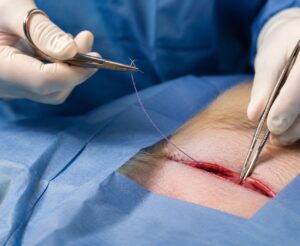
For external skin closure, non-absorbable monofilament sutures are the standard choice. Nylon and polypropylene are widely used because of their strength, smooth tissue passage, and low reactivity. They are placed with the intention of removal at 10 to 14 days post-operatively. In contaminated wounds or lacerations, monofilament construction is particularly important because it minimizes bacterial wicking along the suture line.
For subcuticular skin closure, synthetic absorbable monofilaments are preferred. Poliglecaprone 25 is a popular option because it handles well, absorbs predictably within 90 to 120 days, and causes minimal tissue reaction. This approach is useful in animals where suture removal would be difficult or stressful.
Detailed guidance on skin-specific suture decisions is available in the guide on how to choose the best sutures for skin closure in vet practice.
The subcutaneous layer requires temporary support to eliminate dead space and reduce tension on the overlying skin closure. Absorbable sutures are almost universally selected here because long-term foreign body presence in this layer is unnecessary and may contribute to seroma formation or chronic inflammation.
Polyglactin 910 and polyglycolic acid are commonly used for subcutaneous closure. Both are braided absorbable sutures that offer excellent knot security, which is valuable when working in a relatively loose tissue plane. Their absorption timelines of 60 to 90 days align well with the healing rate of subcutaneous fat.
Poliglecaprone 25 or polydioxanone in monofilament form are also appropriate here, particularly when infection risk is elevated or when a less reactive material is preferred.
Muscle and fascial tissues experience significant mechanical loading and heal more slowly than skin or subcutaneous layers. Sutures placed in these tissues must retain tensile strength for an extended period to prevent dehiscence, particularly in the abdominal wall.
Polydioxanone is frequently selected for fascial closure because of its prolonged tensile strength retention. It maintains approximately 50 percent of its original strength at 28 days and around 25 percent at 42 days, providing support well into the proliferative phase of healing. Its monofilament structure also reduces the risk of infection in body cavity closures.
Polyglactin 910 in a larger gauge is another option for muscle closure in lower-tension situations. For abdominal wall closures in large breed dogs or in cases where prolonged support is critical, non-absorbable sutures such as polypropylene may be selected for permanent reinforcement.
Understanding the absorption timelines of materials used in these layers is covered in how long does absorbable sutures last in veterinary procedures.
Gastrointestinal surgery presents specific challenges. The gut lumen is heavily colonized with bacteria, and sutures placed here must resist bacterial wicking while providing reliable tissue apposition. Monofilament absorbable sutures are the preferred choice for most gastrointestinal closures.
Poliglecaprone 25 and polydioxanone are both widely used for intestinal anastomoses and enterotomy closures. Their smooth surfaces reduce drag through the delicate mucosal layers and minimize the risk of bacterial contamination tracking along the suture. Polyglactin 910 is also used in some gastrointestinal applications, though its braided structure requires careful technique to manage contamination risk.
Natural absorbable materials such as chromic catgut are used less frequently in gastrointestinal surgery because of their less predictable absorption and higher tissue reactivity. A detailed look at the applications and limitations of chromic catgut is provided in exploring chromic catgut suture uses in animal soft tissue repair.
Non-absorbable sutures are generally avoided in gastrointestinal closures because permanent foreign material in contact with gut contents can become a focus for calculus formation or chronic infection.
The bladder, uterus, and associated structures are exposed to urine or reproductive secretions, which can affect suture integrity and contribute to stone formation if permanent materials are left in contact with the luminal surface. Absorbable sutures are strongly preferred in these locations.
For bladder closure, monofilament absorbable sutures are recommended to avoid the capillary action of braided materials in a urine-rich environment. Polydioxanone and poliglecaprone 25 are both appropriate options. Polyglycolic acid sutures are used in some urogenital procedures, particularly for ligatures and pedicle closures during spay procedures, because of their reliable knot security and predictable absorption.
The common polyglycolic acid suture uses across different vet specialties outlines in detail where this material performs well across multiple body systems.
Oral tissues heal rapidly due to the rich vascularity of the oral cavity and the constantly moist, enzyme-rich environment. Absorbable sutures are the standard choice because removal of oral sutures in veterinary patients is often impractical and stressful.
Polyglactin 910 and polyglycolic acid are commonly used for gingival flap closures and oral mucosal repairs. Their good handling characteristics and reliable knot security make them practical in the confined space of the oral cavity. The moist environment of the mouth may accelerate absorption slightly compared to other tissue locations, which generally aligns well with the rapid healing of oral tissues.
Chromic catgut is occasionally used in oral surgery, particularly for short-term mucosal approximation, as described in the chromic catgut suture blog referenced earlier.
Laceration repair in veterinary patients encompasses a range of tissue depths and wound types. The suture selection for laceration repair depends on the depth of the wound, the degree of contamination, and the tissues involved.
For superficial lacerations with minimal contamination, monofilament non-absorbable sutures placed in an interrupted pattern offer reliable and easily monitored closure. In more complex lacerations involving subcutaneous tissue or muscle, a layered closure approach is used, with absorbable sutures in the deeper layers and non-absorbable or subcuticular absorbable sutures at the skin surface.
Contaminated lacerations are best managed with monofilament materials at every layer to reduce infection risk. The common types of suture for laceration used in veterinary surgery provides a focused guide to the specific materials and patterns used in laceration management.
These specialized tissues require sutures with very high tensile strength, minimal tissue reactivity, and in most cases, permanent support. Non-absorbable monofilament sutures such as polypropylene are the preferred choice for cardiovascular procedures. Polypropylene is inert, has a very smooth surface, and is resistant to degradation over time, making it suitable for permanent vascular repairs.
Neurological tissues are extremely delicate and require fine-gauge materials with the lowest possible tissue reactivity. Monofilament non-absorbable sutures in small gauges are typically used, with precise technique being as important as material selection.
In orthopedic surgery, sutures are used for soft tissue repairs including ligament reconstruction, tendon repair, joint capsule closure, and periosteal approximation. These applications demand sutures with high tensile strength and the ability to withstand the biomechanical forces experienced during early post-operative mobilization.
Non-absorbable sutures such as nylon and polyester are commonly used in extracapsular stabilization procedures for cruciate ligament repair. For joint capsule and fascial closures associated with orthopedic approaches, polydioxanone is often selected because it provides prolonged support during the early healing phase. The role of sutures in joint repair is covered extensively in how orthopedic sutures are used in veterinary joint repair procedures.
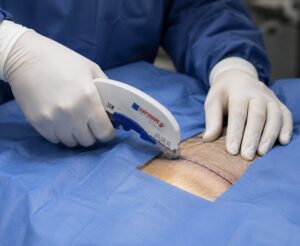
In some tissue types and wound configurations, sutures work best when combined with other closure methods. Topical skin adhesive applied over a subcuticular closure provides an additional barrier against surface contamination. Disposable skin staplers offer an efficient alternative to hand-placed sutures for long skin incisions. These options are explored in how disposable skin stapler use supports faster healing for pets.
Even with the correct material selected for a given tissue type, the quality of the suture itself influences outcomes. Sutures that are poorly manufactured, inconsistently coated, or improperly stored may fail to perform as expected. Sourcing veterinary sutures from reliable suppliers is therefore an important part of delivering consistent surgical results.
A well-applied suture selection guide helps veterinary professionals match the right material to the right tissue every time. From fast-healing oral mucosa to the demanding environment of fascial and orthopedic closures, the appropriate choice of wound closure sutures varies significantly based on tissue biology, mechanical load, and infection risk. By understanding these variables and the properties of available veterinary sutures, practitioners can achieve more reliable healing outcomes and reduce the likelihood of post-operative complications.
Strouden provides a comprehensive range of high-quality veterinary sutures suited to every tissue type and surgical application. To explore our full product range or discuss your practice’s specific needs, please contact us today.
A: Match the suture’s absorption timeline and tensile strength to the tissue’s healing rate and mechanical demands. Fast-healing tissues like oral mucosa suit short-term absorbables, while slow-healing fascia requires prolonged support from materials like polydioxanone.
A: In most internal tissues, absorbable sutures are preferred because they eliminate the need for removal and reduce long-term foreign body presence. However, cardiovascular and some orthopedic applications may require permanent non-absorbable support.
A: Monofilament sutures have a smooth, single-strand construction that resists bacterial wicking. Braided sutures have microscopic interstices where bacteria can harbor, increasing infection risk in contaminated or high-risk surgical environments.
A: While some materials like polydioxanone can be used in both layers, it is generally better to select material properties specific to each tissue’s needs. Muscle and fascia often require longer support than skin, so matching the material to the layer improves outcomes.
A: Monofilament sutures are recommended for contaminated lacerations at every tissue layer. Their smooth surface reduces bacterial adherence, and a layered closure approach using absorbable materials internally and non-absorbable or subcuticular absorbable materials at the skin is standard practice.