
Contents
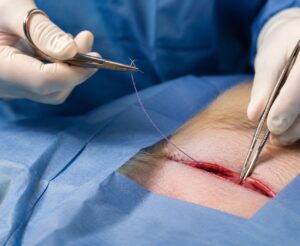
In veterinary surgery, closing the skin is only one part of the wound closure process. Beneath the surface, multiple tissue layers including fascia, muscle, subcutaneous fat, and organ walls must be carefully approximated to support healing from the inside out. Choosing the right deep tissue suture for each of these layers is a decision that carries significant clinical consequences. A poorly selected suture in a deep tissue plane can lead to wound dehiscence, dead space accumulation, organ complications, or prolonged healing, all of which are largely preventable with informed material selection.
Unlike skin closure, where the suture can be monitored and removed, deep tissue sutures work invisibly within the body. This makes the initial selection more critical because there is no opportunity to intervene once the outer layers are closed. Understanding the properties of available suture material types, the demands of different deep tissue environments, and the principles of absorbable suture behavior is essential for every veterinary professional performing internal closures.
Deep tissue closure differs from skin closure in several fundamental ways that directly influence suture selection.
First, sutures placed in deep tissues must be either absorbable or intentionally permanent. There is no practical option for removing internal sutures under most circumstances. This means the suture must provide adequate support during the healing period and then either degrade predictably within the body or remain as a stable, biologically tolerated implant.
Second, different deep tissue types heal at very different rates. The oral mucosa heals within days, while dense fascial tissue may take weeks to develop meaningful intrinsic tensile strength. The suture placed in each environment must match that healing rate, providing support for precisely as long as the tissue needs it without persisting unnecessarily as a foreign body.
Third, deep tissue environments carry specific risks that influence suture choice. The gastrointestinal tract is colonized by bacteria, making infection control a priority. The bladder contains urine, which can interact with certain suture materials. The abdomen is a sterile environment that must remain so. Each of these factors shapes which suture material types are appropriate.
For a broader framework on tissue-specific suture selection, the suture selection guide for different tissue types in animals provides a comprehensive reference across multiple anatomical locations.

Before examining specific materials and applications, it helps to define what properties a deep tissue suture must possess to perform effectively.
The suture must maintain mechanical strength for long enough to support the tissue through its critical healing phases. This duration varies significantly between tissue types and must be considered when selecting among the different types of sutures available.
For absorbable sutures placed internally, the rate of degradation should be predictable and consistent. Unpredictable absorption, such as that associated with enzymatically degraded natural sutures, introduces uncertainty into surgical planning and post-operative management. Synthetic absorbable sutures that degrade through hydrolysis offer more reliable and consistent behavior.
All foreign materials provoke some degree of tissue response. In deep tissues, where the inflammatory environment directly affects healing quality and organ function, minimizing suture-induced inflammation is important. Synthetic suture material types generally provoke less tissue reaction than natural materials.
Monofilament sutures are preferred in contaminated or high-bacterial environments because they do not harbor bacteria through capillary wicking. Braided sutures offer superior knot security and handling ease, which is valuable in clean, low-risk tissue planes. The structural implications of this choice are covered in detail in what vets need to know about braided vs monofilament suture.
Deep tissue knots cannot be checked or revised after closure. The suture must hold its knot reliably throughout the healing period, and the surgeon must have confidence in the security of each tie placed internally.
This category contains the most widely used deep tissue sutures in modern veterinary practice. Synthetic absorbable monofilaments offer a combination of smooth tissue passage, low bacterial adherence, predictable hydrolytic degradation, and acceptable handling characteristics that makes them suitable across a wide range of internal applications.
Polydioxanone is one of the most clinically important sutures in this group. Its extended tensile strength retention, maintaining approximately 50 percent of original strength at four weeks and meaningful support through six weeks, makes it the material of choice for slowly healing or mechanically demanding deep tissues such as fascia, abdominal wall, and orthopedic soft tissue repair. Its complete absorption occurs over 180 to 240 days through hydrolysis, during which time it is well tolerated in body cavities and organ environments. A detailed examination of its behavior in tissue is available in understanding polydioxanone suture absorption time in animals.
Poliglecaprone 25 is another synthetic absorbable monofilament used in deep tissue applications, particularly in rapidly healing tissues or where a shorter support duration is appropriate. It loses tensile strength within one to two weeks and absorbs completely within 90 to 120 days. It is frequently used for subcuticular closure and selected gastrointestinal applications where its smooth passage and low reactivity are clinical advantages.
Braided absorbable sutures remain widely used in deep tissue surgery, particularly in clean surgical environments where the handling and knot security advantages of braided construction are beneficial.
Polyglactin 910 is a braided synthetic absorbable suture that retains tensile strength for approximately two to three weeks and is fully absorbed within 56 to 70 days. It is a practical and popular choice for subcutaneous tissue closure, organ pedicle ligation during procedures such as ovariohysterectomy, and general soft tissue approximation in clean surgical fields. Its excellent knot security makes it reliable for ligatures where tie security is critical.
Polyglycolic acid is a structurally similar braided absorbable suture with a comparable absorption profile of 60 to 90 days. It performs well across a range of soft tissue applications and is particularly valued in oral surgery and urogenital procedures. The full scope of its clinical utility is outlined in common polyglycolic acid suture uses across different vet specialties.
Chromic catgut is a natural deep tissue suture derived from purified collagen and treated with chromic salts to extend its degradation time. It retains tensile strength for approximately 10 to 14 days and is absorbed through enzymatic breakdown within 60 to 90 days. While its handling characteristics are generally favorable, the variability of enzymatic degradation and its tendency to provoke a higher tissue reaction than synthetic alternatives have led most modern veterinary practices to prefer synthetic absorbable sutures for deep tissue applications.
Chromic catgut remains used in specific contexts, including oral mucosal closure and selected ligature applications, where its biological origin and short support duration are clinically appropriate. Its properties and appropriate uses are discussed in exploring chromic catgut suture uses in animal soft tissue repair.
In certain deep tissue applications, permanent mechanical support is required and absorbable sutures are not appropriate. Cardiovascular repairs, some neurological procedures, and specific orthopedic applications fall into this category.
Polypropylene is the most widely used non-absorbable suture for internal permanent applications. It is a monofilament synthetic material with very low tissue reactivity, excellent long-term stability, and resistance to degradation over extended periods. It is the standard choice for cardiovascular suture lines where permanent integrity is essential.
Non-absorbable braided sutures such as polyester are used in specific orthopedic applications, including prosthetic ligament repairs and permanent joint stabilization procedures. Their braided construction provides the tensile strength and knot security needed for these mechanically demanding applications.
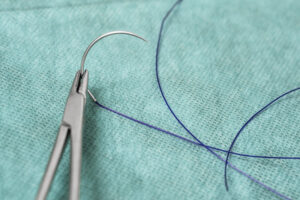
The linea alba and fascial layers of the abdominal wall are among the most mechanically demanding deep tissue environments in veterinary surgery. These dense connective tissue structures heal slowly and bear the internal pressures generated by respiration, defecation, and movement throughout the post-operative recovery period.
Polydioxanone in an appropriate gauge is the preferred deep tissue suture for fascial closure in most small animal patients. Its six-week tensile strength retention provides support well beyond the critical early healing phase. In large breed dogs, size 0 or 1 is appropriate, while cats and small breed dogs are typically closed with 2-0 or 3-0.
A simple continuous or interrupted pattern using polydioxanone provides reliable abdominal wall closure in the majority of routine cases. In patients with compromised healing, such as those with hypoproteinemia or metabolic disease, a more conservative approach using interrupted sutures allows individual sutures to bear independent load and prevents total closure failure if one suture is lost.
The gastrointestinal tract presents a uniquely challenging environment for deep tissue sutures. The luminal surface is colonized by billions of bacteria, and any suture material that provides a pathway for bacterial migration can lead to peritoneal contamination or anastomotic failure. This makes monofilament construction essential for any suture in contact with the gastrointestinal lumen.
Poliglecaprone 25 and polydioxanone are both appropriate for intestinal anastomoses and enterotomy closures. The choice between them depends on the anticipated healing time and the mechanical demands of the repair. For most routine small animal gastrointestinal procedures, poliglecaprone 25 in 3-0 or 4-0 provides adequate support. In cases where slower healing is anticipated, polydioxanone offers a more extended support duration.
Appositional suture patterns are generally preferred in gastrointestinal surgery to avoid inverting or everting tissue, which can compromise lumenal diameter or tissue apposition quality.
Bladder closure and uterine repair require sutures that are compatible with a urine-exposed environment and that do not provide a nidus for calculus formation. Monofilament absorbable sutures are strongly preferred for bladder closure because their smooth surface resists crystal deposition and bacterial adherence.
Polydioxanone is well suited to bladder repair because of its prolonged support and monofilament construction. Poliglecaprone 25 is also used in selected urogenital applications. Braided absorbable sutures are avoided on the mucosal surface of the bladder because of the risk of suture calculi forming around the braided material.
For uterine closure and ligature applications during ovariohysterectomy, braided absorbable sutures such as polyglactin 910 are commonly used for pedicle ligation in the deeper body cavity, where infection risk is lower and knot security is the priority.
Muscle closure requires sutures with sufficient tensile strength to support the repair through the initial healing period. The specific suture choice depends on whether the closure is under tension and how quickly the muscle tissue is expected to heal in the individual patient.
For routine muscle layer closure in small animals, 2-0 or 3-0 absorbable suture in either braided or monofilament form is appropriate. In high-tension muscle repairs, polydioxanone provides a longer support duration. Simple interrupted or simple continuous patterns are both used depending on the clinical context.
The subcutaneous layer primarily needs suture support to eliminate dead space and reduce tension transferred to the overlying skin closure. Braided absorbable sutures such as polyglactin 910 or polyglycolic acid are the standard choice here. Their handling ease and knot security are advantages in this tissue plane, and because the subcutaneous layer is a relatively clean surgical environment, the slightly higher infection risk of braided construction is not a significant concern.
Appropriate gauge selection for this layer follows the same principles as other internal tissues. A 3-0 braided absorbable suture suits most small animal subcutaneous closures, while 2-0 or 0 may be required in larger patients with deeper subcutaneous tissue.
Joint capsule closure, periosteal repair, and fascial closure associated with orthopedic approaches all require sutures with good tensile strength and, in most cases, extended support duration. Polydioxanone is frequently selected for these applications in its appropriate gauge.
Extracapsular stabilization procedures for cruciate ligament disease use non-absorbable sutures in heavier gauges to provide permanent mechanical support to the stifle joint. Nylon leader material and polyester sutures are used in these specialized applications. The broader context of orthopedic suture use is discussed in how orthopedic sutures are used in veterinary joint repair procedures.
The choice of suture pattern for deep tissue closure affects both the mechanical integrity of the repair and the efficiency of the surgical procedure.
Simple interrupted patterns provide the highest security because the failure of one suture does not compromise adjacent sutures. This pattern is preferred in high-stakes closures such as fascial repair and gastrointestinal anastomosis where the consequence of partial failure is significant.
Simple continuous patterns are faster to place and distribute tension evenly along the suture line. They are appropriate in lower-risk tissue planes such as subcutaneous closure and selected muscle approximation. The risk of total failure if the strand breaks is mitigated by careful technique and appropriate gauge selection.
Cruciate and horizontal mattress patterns are used in specific deep tissue applications where additional tension relief is needed, such as closing fascial defects under high tension or approximating tissue planes that cannot be brought together without strain.
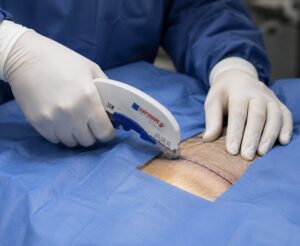
Deep tissue closure works as part of a complete wound management strategy. Once internal layers are secured with the appropriate deep tissue suture, the skin can be closed using the methods best suited to the patient and wound type. Options including monofilament skin sutures, subcuticular absorbable patterns, surgical staples, and topical adhesive each serve specific clinical purposes.
The use of skin staplers for efficient external closure following internal suture placement is discussed in how disposable skin stapler use supports faster healing for pets.
The selection of the correct suture material type is only valuable if the suture itself is manufactured to a consistent standard. Sutures from reliable suppliers maintain predictable tensile strength, consistent coating, and guaranteed sterility, all of which directly support reliable deep tissue closure outcomes.
Practices sourcing surgical supplies should prioritize quality and consistency, as discussed in the importance of medical supplies in building trust.
Choosing the right deep tissue suture in veterinary surgery requires a clear understanding of tissue healing rates, the mechanical demands of each tissue plane, the infection risk of the surgical environment, and the properties of available absorbable and non-absorbable suture material types. Synthetic absorbable monofilaments such as polydioxanone and poliglecaprone 25 cover the majority of deep tissue applications in small animal practice, while braided absorbable sutures remain valuable in clean tissue planes where handling and knot security are priorities. Non-absorbable sutures are reserved for applications requiring permanent internal support.
By matching suture properties to tissue demands at every layer, veterinary professionals can close wounds with confidence and give each patient the best foundation for healing from the inside out.
Strouden provides a comprehensive range of veterinary sutures suited to deep tissue applications across all surgical specialties. To explore our full product range or discuss the right suture solutions for your practice, please contact us today.
A: Polydioxanone is widely preferred for slowly healing deep tissues such as fascia and abdominal wall because of its extended tensile strength retention. Poliglecaprone 25 suits faster-healing internal tissues. The right choice depends on the tissue type and expected healing timeline.
A: Monofilament sutures have a smooth surface that resists bacterial wicking, which is critical in the bacteria-rich gastrointestinal environment. Braided sutures have microscopic spaces between strands where bacteria can migrate, increasing the risk of anastomotic infection and peritoneal contamination.
A: Yes, in certain applications permanent internal support is required. Polypropylene is used for cardiovascular repairs, and polyester or nylon is used in orthopedic stabilization procedures. In most routine soft tissue applications, however, synthetic absorbable sutures are preferred.
A: In clean surgical environments with low contamination risk, braided absorbable sutures offer practical handling advantages for muscle closure. In potentially contaminated fields or where infection risk is elevated, monofilament sutures are the safer choice because they do not support bacterial migration.
A: Using the correct gauge for the tissue ensures adequate mechanical support without placing excess foreign material in the wound. An oversized suture increases tissue reaction and inflammatory burden, while an undersized suture may fail under tension, leading to dehiscence of the internal repair.