
Contents
Among the innovations that have entered veterinary surgical practice in recent years, knotless barbed sutures have attracted significant interest for their ability to simplify wound closure without compromising reliability. By eliminating the need for knot tying while distributing tension continuously along the entire suture line, barbed surgical sutures address two of the most consistent challenges in conventional veterinary suturing: knot security and tension concentration. Understanding what makes this technology reliable, where it performs best, and how it integrates with the broader range of veterinary sutures available to practitioners is essential for informed adoption.
This article examines the engineering behind knotless barbed sutures, the clinical evidence for their reliability, the specific procedures and tissue types where they offer genuine advantages, and the important considerations that should guide their use in veterinary surgical practice.
Conventional smooth sutures rely on knots at the ends of each suture segment to maintain the holding force that keeps wound edges in apposition. Every knot represents a concentration of mechanical stress, a potential point of failure, and an additional volume of foreign material at a discrete location within the tissue. The reliability of a conventional suture closure depends to a significant degree on the security of each individual knot.
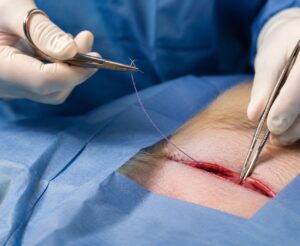
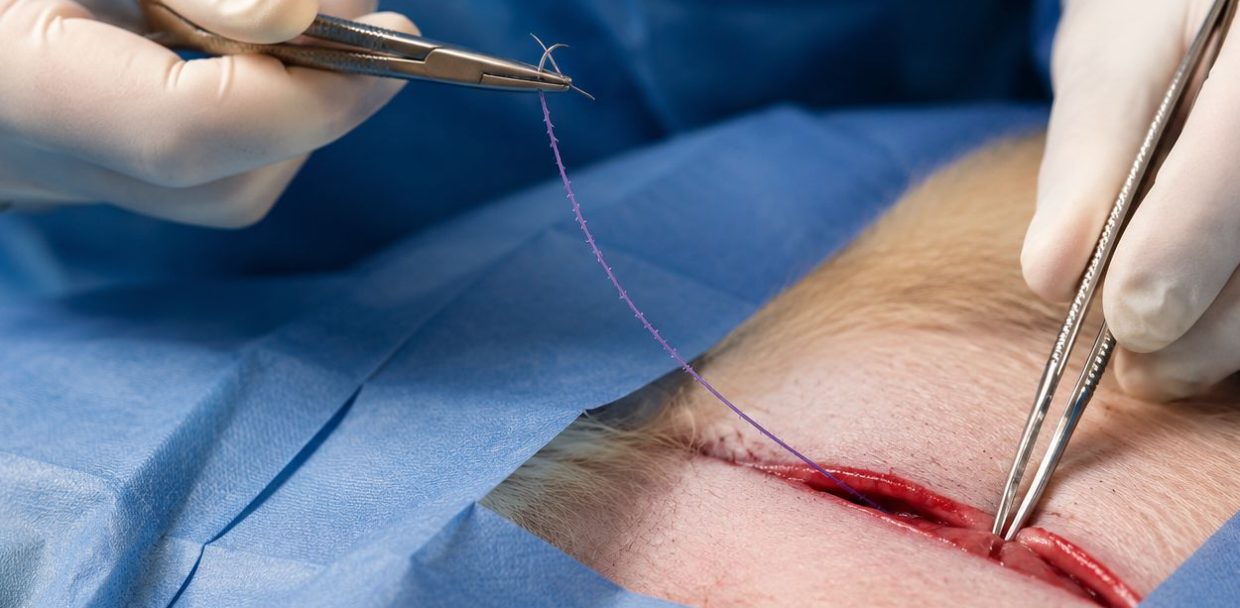
Knotless barbed sutures work through an entirely different mechanism. Along the length of the suture strand, small cuts or projections are made at regular intervals, angled consistently in one or both directions depending on the suture design. These projections interlock with the surrounding tissue as the suture is advanced, anchoring the strand at multiple points along the entire length of the closure rather than only at the terminal knot positions.
For a foundational understanding of how barbed sutures differ from conventional types of sutures including braided and monofilament options, a complete guide to monofilament suture vs multifilament for clinical use provides useful context on suture construction principles.
As each barb engages tissue, it contributes to the holding force of the closure. The cumulative anchoring effect of many barbs distributed along the suture line replaces the concentrated holding force of a knot, resulting in a closure that maintains tension continuously along its full length without requiring any knot to be tied.
Knotless barbed sutures are available in two fundamental configurations that determine how the barbs are oriented and how the suture is deployed.
In a unidirectional design, all barbs are angled in the same direction along the suture length. The suture is anchored at one end by a loop or a needle-based attachment, then advanced through tissue in a single direction with all barbs engaging tissue as the suture progresses. Unidirectional designs are well suited to single-layer closures where the suture begins at one end of the incision and progresses to the other in a continuous running pattern.
In a bidirectional design, the barbs change direction at the midpoint of the suture. From the midpoint, barbs angle toward one end on one half and toward the other end on the other half. The suture is introduced at the center of the wound and run in both directions simultaneously, meeting at each end of the incision and securing the closure without a terminal knot. This design allows tension to be distributed from the center of the wound outward in both directions, producing more even tissue apposition along longer incision lines.
Knotless barbed sutures are manufactured in both absorbable and non-absorbable forms. Absorbable barbed sutures are typically manufactured from copolymers of glycolide, dioxanone, and trimethylene carbonate. These materials degrade through hydrolysis with tensile strength retention of approximately three weeks and complete absorption occurring over approximately 180 days. Non-absorbable barbed sutures are most commonly manufactured from polypropylene, providing permanent mechanical support at the wound site.
The complete discussion of whether barbed sutures dissolve and how they interact with tissue healing stages is provided in do barbed sutures dissolve in animal surgeries.
In conventional veterinary sutures, knot failure is a recognized source of wound complication. Inadequate throws, imprecise technique, suture memory in monofilament materials, and the physical stress of post-operative movement can all contribute to knot slippage. In deeply placed internal sutures where the knot cannot be checked or revised after closure, undetected knot failure can lead to wound dehiscence with serious consequences.
Knotless barbed sutures eliminate this failure mode entirely. There are no knots to slip, no throws to count, and no technique-dependent knot security variable. The holding force is distributed across all barb-tissue interfaces along the suture length, and the failure of any single barb-tissue interface is compensated for by the continued engagement of all other barbs. This distributed anchoring mechanism is inherently more resistant to localized failure than a closure dependent on a small number of discrete knots.
This reliability characteristic is particularly meaningful in laparoscopic and minimally invasive procedures, where intracorporeal knot tying is technically demanding and where knot security is more difficult to verify. For guidance on suture selection more broadly in these internal applications, how to choose the right deep tissue suture for vet surgery provides a comprehensive reference.
In conventional suture closures, tension concentrates at each knot site. This concentration can create localized ischemia in the tissue immediately adjacent to the knot, slowing cellular repair and potentially contributing to suture site complications. The tissue between sutures may also receive less approximating force than the tissue directly at the suture bites, producing slight variations in closure quality along the wound length.
Knotless barbed sutures distribute tension continuously along the entire length of the wound. Every barb-tissue interface contributes holding force, and the spacing of barbs along the suture strand means that tissue is supported uniformly rather than at discrete points. This continuous tension distribution reduces localized ischemia at any single point and produces more uniform wound edge apposition across the full closure length.
Knot tying quality varies between practitioners and is significantly influenced by experience, fatigue, working space, and the specific suture material being used. Monofilament sutures require more throws and more deliberate technique than braided materials to achieve equivalent knot security. In confined spaces or during long procedures, even experienced surgeons may produce knots of variable security due to fatigue or limited access.
Knotless barbed sutures significantly reduce the technique-dependence of closure quality. Because the holding mechanism is built into the suture construction rather than dependent on the surgeon’s knot-tying skill, closure reliability is more consistent across practitioners with different experience levels. This is a meaningful advantage in teaching environments and in any procedure where confined anatomy makes knot tying technically challenging.
The comparison between barbed and conventional suture reliability in tissue-specific applications is contextualized further in the suture selection guide for different tissue types in animals.
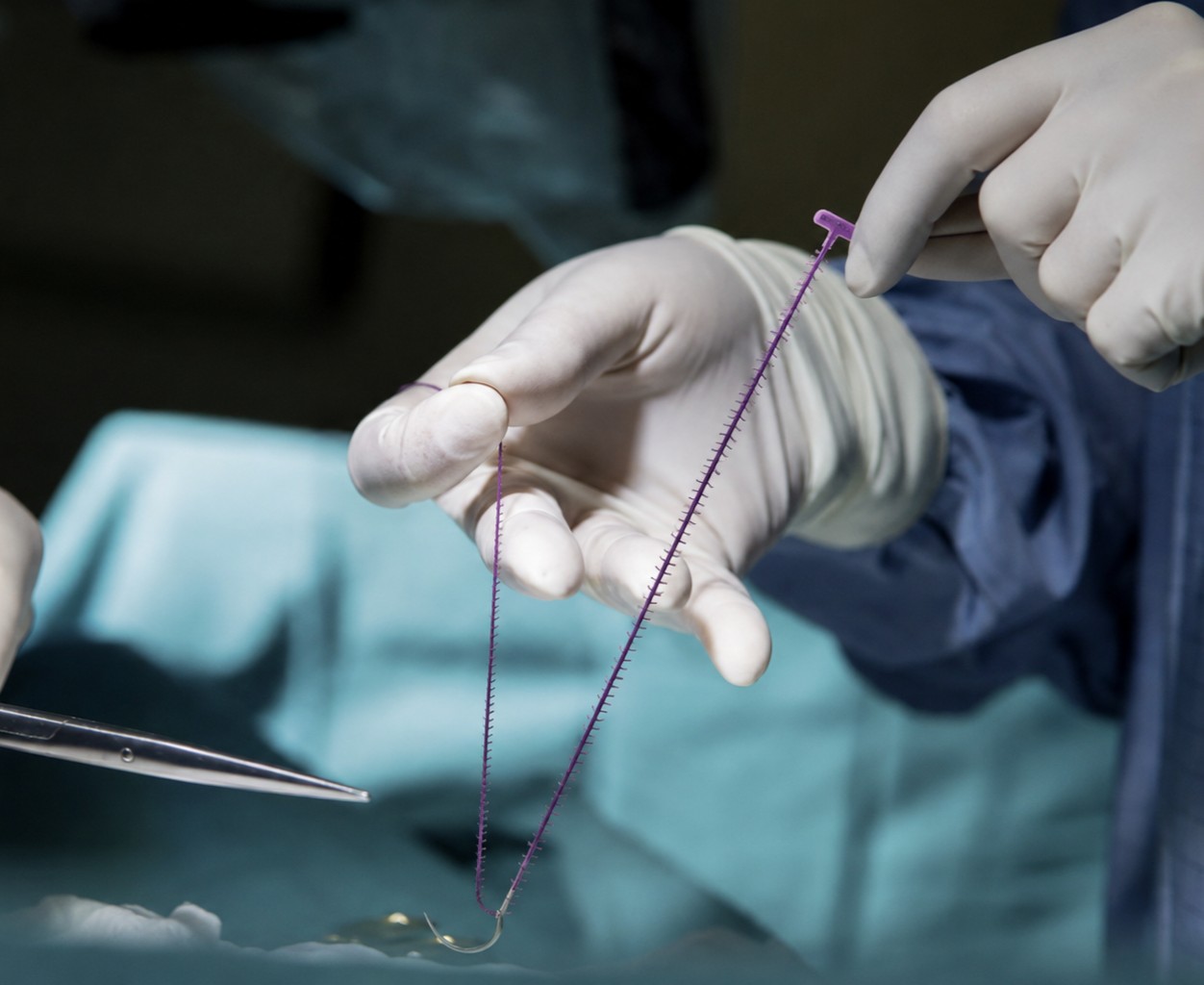
The subcutaneous and subcuticular layers are among the most practical applications for knotless barbed sutures in veterinary practice. Eliminating knots in these layers removes palpable knot masses beneath the skin surface that can be uncomfortable for the patient and visible to owners in thin-skinned animals. The continuous tension distribution of a barbed suture closure produces smooth, even subcuticular apposition that supports excellent cosmetic outcomes when combined with a surface tissue adhesive.
The absence of external hardware and the smooth subcutaneous closure make this combination particularly appealing for fractious patients, for animals in which a return visit for suture removal is impractical, and for owners with cosmetic expectations. The role of tissue adhesive as a complement to internal barbed suture closure is discussed in when veterinary tissue adhesive is a better option than staples or sutures for pets.
Barbed sutures have been applied to body wall closure in veterinary patients, where the continuous running design allows rapid closure of the linea alba or fascial layer without the need for multiple interrupted knots. The distributed tension mechanism may provide more even load distribution across the fascial closure than a conventional running suture with terminal knots, potentially reducing the risk of focal stress concentration at suture attachment points.
However, the mechanical demands of fascial closure are significant, and conventional polydioxanone remains the established benchmark for this application in most practices. The absorption behavior and clinical positioning of polydioxanone in these demanding applications is covered in understanding polydioxanone suture absorption time in animals.
Prophylactic and therapeutic gastropexy for prevention and management of gastric dilatation-volvulus in predisposed breeds is an application where knotless barbed sutures have shown meaningful clinical utility. The knot-free running closure simplifies the procedure, particularly in laparoscopic gastropexy where intracorporeal knot tying is a recognized technical challenge. The distributed tension of the barbed closure supports even apposition of the gastric and body wall tissue along the full attachment length, contributing to the quality and durability of the adhesion.
The most compelling application of knotless barbed sutures in veterinary medicine is in minimally invasive surgery. Laparoscopic ovariohysterectomy, laparoscopic gastropexy, thoracoscopic procedures, and other minimally invasive approaches all require suturing within a confined body cavity through working ports. Intracorporeal knot tying in these conditions is technically demanding, time-consuming, and requires a high level of operator skill.
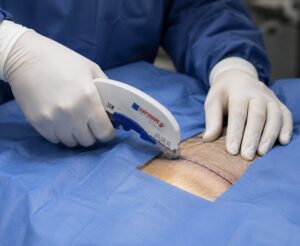
Knotless barbed sutures allow running closure within the body cavity without any intracorporeal knot tying. For skin closure following these minimally invasive procedures, complementary options including disposable skin staplers provide efficient external closure, as discussed in how disposable skin stapler use supports faster healing for pets.
Knotless barbed sutures are used in a range of veterinary soft tissue procedures including cystotomy closure, reproductive tract procedures, and selected intestinal applications. In these tubular or rounded structures, the running barbed closure allows even circumferential apposition without the technique complexity of placing multiple interrupted sutures in a confined working space.
Factor |
Knotless Barbed Sutures |
Conventional Smooth Sutures |
| Knot tying required | No | Yes |
| Tension distribution | Continuous, distributed | Concentrated at knots |
| Technique dependence | Lower | Higher |
| Laparoscopic suitability | Excellent | Challenging |
| Risk of knot failure | Eliminated | Present |
| Suitability as ligature | Not appropriate | Standard application |
| Cost | Generally higher | Lower per unit |
| Removal if needed | Difficult due to barb engagement | Straightforward for external sutures |
| Available in absorbable form | Yes | Yes |
| Available in non-absorbable form | Yes | Yes |
Knotless barbed sutures are not appropriate for ligating blood vessels or organ pedicles. Ligation requires a concentrated, localized holding force at a fixed point that prevents the ligated vessel from reopening under blood pressure. The distributed anchoring mechanism of barbed sutures is designed for linear wound closure and does not provide the localized mechanical security that hemostatic ligation requires. Conventional knotted sutures or ligating clips remain the appropriate choice for all ligature applications.
The barbed construction that gives these sutures their holding power also makes them very difficult to remove once placed, because the barbs engage tissue in the direction opposite to withdrawal. For internal absorbable barbed sutures this is not a clinical concern, as the suture will degrade and absorb without requiring removal. However, if a non-absorbable barbed suture needs to be removed due to infection or complication, surgical exploration is required.
Suture reactions and the clinical scenarios in which suture removal becomes necessary are discussed in understanding suture reactions in dogs for better post-op recovery.
Knotless barbed sutures are generally more expensive per unit than conventional smooth sutures of equivalent material and gauge. For high-volume routine procedures, this cost difference accumulates across cases and may influence adoption decisions. The reduction in procedural time associated with eliminating knot tying may partially offset this cost in high-throughput settings, but the economic calculation is practice-specific. Guidance on managing veterinary surgical supply costs is available in the guide to buying wholesale medical supplies.
The barbed projections along the suture strand increase the effective surface area of suture material in contact with tissue relative to a smooth suture of equivalent gauge. This greater tissue-suture interface may amplify the foreign body inflammatory response modestly. In most healthy veterinary patients this difference is clinically minor, but in immunocompromised animals or patients with a history of exaggerated suture reactions, the additional tissue contact surface is worth considering in material selection.
Knotless barbed sutures represent one category within the full range of types of sutures available to veterinary professionals. They do not replace conventional sutures across the board but offer specific and genuine advantages in the applications described above. A sound suture selection framework incorporates barbed sutures as a tool for specific clinical contexts rather than as a universal closure method.
The comparison between braided and monofilament conventional suture types, which forms the foundation for understanding how barbed sutures fit within the broader landscape, is covered in what vets need to know about braided vs monofilament suture. For the complete wound closure toolkit including tissue adhesive and stapler options that work alongside barbed sutures, key benefits of vet skin glue for faster healing in pets provides relevant complementary information.
Knotless barbed sutures have earned their place in the veterinary surgical toolkit through a combination of engineering logic and clinical performance. By eliminating knot tying, distributing tension uniformly along the wound, and reducing the technique-dependence of closure quality, barbed surgical sutures address real and consistent challenges in conventional veterinary suturing. Their particular strength in laparoscopic and minimally invasive applications positions them well for continued adoption as these techniques expand in veterinary practice.
Used in the right applications, with a clear understanding of their limitations including unsuitability for ligature use, difficulty of removal, and higher cost, knotless barbed sutures are a reliable and clinically valuable addition to the range of veterinary sutures available for wound closure.
Strouden supplies a comprehensive range of veterinary sutures across all types and constructions to support informed, high-quality surgical practice. To explore our full product range or discuss the right suture solutions for your practice, please contact us today.
A: Knotless barbed sutures have small projections along their length that grip tissue as the suture is advanced, distributing holding force continuously without requiring knots. Each barb anchors the suture at its tissue contact point, replacing the concentrated holding force of terminal knots with distributed engagement across the full closure.
A: Yes, absorbable versions are available and manufactured from synthetic copolymers that degrade through hydrolysis. They retain tensile strength for approximately three weeks and absorb completely over approximately 180 days. Non-absorbable barbed sutures made from polypropylene are also available for applications requiring permanent support.
A: No. Barbed sutures are not suitable for ligating blood vessels or organ pedicles because their distributed anchoring mechanism does not provide the concentrated, localized holding force required for hemostatic ligation. Conventional knotted sutures or ligating clips are the appropriate choice for all ligature applications in veterinary surgery.
A: Intracorporeal knot tying in laparoscopic procedures is technically demanding and time-consuming. Knotless barbed sutures allow running closure within the body cavity without any knot tying, simplifying the procedure significantly and reducing operative time. This makes reliable closure more accessible across different levels of laparoscopic surgical experience.
A: Key limitations include unsuitability for ligature applications, difficulty of removal once placed due to barb engagement in tissue, higher cost compared to conventional sutures, and a modest increase in tissue-suture contact surface. These factors should be weighed against their advantages when deciding whether to use barbed sutures for a specific procedure.