
Contents
A question that comes up regularly among veterinary students and newer practitioners is whether nylon sutures are absorbable. The short answer is no. Nylon sutures are classified as non-absorbable, meaning they do not degrade within the body through biological processes and must be removed after the wound has healed sufficiently. However, the full clinical picture is more nuanced than this simple classification suggests, and understanding why nylon behaves the way it does in animal tissue helps practitioners use it more effectively in skin closure procedures.
This article examines the properties of nylon sutures in detail, addresses the question of whether nylon sutures are absorbable, explains how nylon performs in the context of wound healing in animal surgery, and outlines when it is the appropriate choice compared to other stitches medical professionals use in veterinary practice.
Nylon, chemically known as polyamide, is a synthetic polymer suture that belongs to the non-absorbable category. Non-absorbable sutures are defined by their ability to maintain tensile strength over an extended period without being broken down by the biological processes of the host. When placed in tissue, nylon sutures remain structurally intact and are typically encapsulated by fibrous connective tissue over time.
Because nylon is not degraded through hydrolysis or enzymatic breakdown in the same manner as absorbable materials, it provides durable mechanical support that can last months to years if left in place. For external skin closures, this means the suture must be deliberately removed by the veterinary team once the wound has reached adequate strength, typically between 10 and 14 days post-operatively depending on the site and the patient.
For a thorough comparison of absorbable and non-absorbable categories, key differences in absorbable vs non-absorbable sutures every veterinarian should know provides a solid clinical foundation.
While the answer to “are nylon sutures absorbable” is clearly not in the conventional sense, it is worth noting that nylon does undergo very slow hydrolytic degradation over years when left in tissue. This process is so gradual that it has no meaningful clinical effect during the typical post-operative period, but it does mean that nylon sutures left permanently in the body will very slowly lose some tensile strength over a period of years rather than weeks or months.
This slow degradation is one reason nylon is used with the intention of eventual removal for external closures rather than being left permanently in high-stress applications such as cardiovascular repairs. For permanent internal support, polypropylene, which is more biologically stable over the long term, is often preferred.
Understanding this distinction helps clarify the position of nylon within the broader classification of stitches medical professionals use in animal surgery.
Nylon is one of the most widely used suture materials for external skin closure in veterinary medicine. Its popularity is based on several practical properties.
Nylon offers high initial tensile strength for its gauge. This means a relatively fine diameter suture can hold wound edges securely, which is important in skin closure where the goal is to minimize tissue trauma while still providing reliable apposition.
Most nylon sutures used in veterinary skin closure are monofilament. This single-strand construction provides a smooth surface that passes easily through tissue with minimal drag. It also resists bacterial wicking, making nylon an appropriate choice for contaminated wounds or lacerations where infection risk is elevated. The advantage of this construction is explored in the advantage of monofilament suture in vet surgical applications.
Nylon has a degree of elasticity that allows it to accommodate mild post-operative swelling without cutting into surrounding tissue. This is a clinically useful property in skin closure because swelling in the first 24 to 48 hours after surgery is common, and a suture that can absorb some of this dimensional change reduces the risk of tissue ischemia at the wound edges.
The main handling challenge with nylon is its tendency to return to its original coiled shape, a property known as suture memory. This means nylon sutures require additional knot throws to achieve reliable knot security. Practitioners working with nylon regularly develop technique adjustments that account for this property, but it is an important consideration for those newer to the material.
Nylon is a synthetic material and provokes minimal inflammatory response from surrounding tissues. This low reactivity contributes to clean wound healing and reduces the risk of suture-related complications such as granuloma formation or persistent inflammatory tracts.
In the context of wound healing in animal surgery, nylon sutures serve a clear and well-defined role. They are placed in skin to hold wound edges in apposition during the inflammatory and proliferative phases of healing, then removed once the wound has developed sufficient intrinsic strength.
In the first few days after surgery, the wound is in its most vulnerable state. Nylon sutures bear the majority of the mechanical load during this period, maintaining tissue apposition while the body initiates clot formation and early cellular repair. The low reactivity of nylon means it does not significantly add to the inflammatory burden already present at the healing wound site.
As fibroblasts begin to deposit collagen and new tissue forms across the wound, the tissue progressively gains its own tensile strength. Nylon sutures continue to provide support during this phase, which typically spans days 4 through 14 post-operatively for skin tissue.
By 10 to 14 days in most skin closures, the wound has gained enough strength to maintain apposition without external support, and the sutures are removed. Leaving nylon sutures in place beyond the appropriate window can lead to suture tract formation, where the skin grows around the suture, making removal more difficult and potentially leaving small scars. Timely removal is therefore an important part of the clinical protocol.
Proper post-operative monitoring and suture care are closely related to understanding how wound healing progresses. The article on understanding veterinary surgical wound closure techniques for better recovery discusses these healing stages in detail.
Nylon sutures are well suited to a range of clinical scenarios in veterinary skin closure.
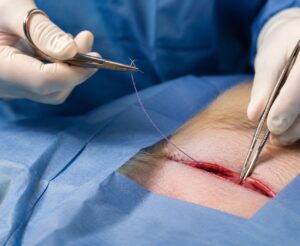
For elective procedures with clean incisions and low infection risk, nylon sutures in a simple interrupted or continuous pattern provide reliable, easily monitored closure. The smooth monofilament surface ensures minimal tissue drag during placement and clean wound apposition throughout healing.
In lacerations or wounds with contamination risk, the monofilament construction of nylon offers an important infection control advantage. Unlike braided sutures, nylon does not provide capillary pathways for bacterial migration along the suture line. For this reason, it is a preferred choice in wound care involving traumatic lacerations. The common types of suture for laceration used in veterinary surgery covers the suture options relevant to these cases in greater detail.
In areas where the skin experiences significant tension, such as over large muscle groups or along the dorsal midline in large breed dogs, the high tensile strength of nylon provides dependable resistance to wound breakdown. This makes it a sound choice for closures that need to withstand the mechanical stresses of post-operative movement.
Fine-gauge nylon sutures are commonly used in ophthalmic procedures for corneal and conjunctival repair. Their precision, smooth passage through delicate tissue, and low reactivity make them well suited to the demanding environment of ophthalmic surgery where tissue handling must be exceptionally gentle.
While nylon is highly capable as a skin closure suture, there are situations where alternative materials are better suited to the clinical needs of the patient.
In fractious animals, very young patients, or cases where a return visit for suture removal is unlikely, an absorbable subcuticular suture eliminates the need for removal entirely. Poliglecaprone 25 is frequently used in these situations because of its smooth monofilament construction and predictable absorption within 90 to 120 days. Combining this with a small amount of veterinary tissue adhesive at the surface provides further protection against wound disruption.
The key benefits of vet skin glue for faster healing in pets outlines why topical adhesive is a valuable adjunct in these cases.
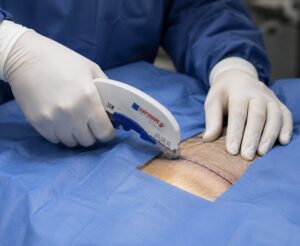
For very long incisions where surgical time needs to be minimized, a disposable skin stapler may be more practical than hand-placed nylon sutures. Staplers provide consistent wound edge eversion and significantly reduce closure time. This option is discussed in benefits of using sterile disposable skin staplers in veterinary practice.
In highly visible areas or in animals where owner expectations for minimal scarring are high, a subcuticular absorbable pattern avoids external skin penetrations entirely and typically produces a finer scar line than interrupted nylon. That said, properly placed fine-gauge nylon sutures also produce excellent cosmetic results in most cases.
Nylon is sometimes compared to polypropylene, another synthetic monofilament non-absorbable suture commonly used in skin closure. Both are appropriate for external skin closure in animal surgery, and both share the properties of low tissue reactivity, monofilament construction, and high tensile strength.
The key difference lies in their long-term behavior in tissue. Polypropylene is more biologically stable over extended periods and does not undergo the very slow hydrolytic degradation seen with nylon. This makes polypropylene the preferred choice for permanent internal applications such as cardiovascular repairs. For external skin closure with planned removal, both materials perform similarly, and the choice often comes down to individual surgeon preference and availability.
Both materials also have suture memory, though polypropylene generally requires careful technique to achieve knot security because of its particularly smooth surface and lower coefficient of friction.
Regardless of material type, the quality of nylon sutures used in animal surgery directly influences clinical outcomes. Consistently manufactured sutures with reliable tensile strength, appropriate coating, and intact packaging perform predictably in the surgical field. Substandard products may introduce contamination, provide inconsistent knot security, or fail to perform as labeled.
Veterinary practices sourcing nylon and other surgical sutures should prioritize reliable suppliers who can guarantee consistent product quality. The importance of medical supplies in building trust explains why material quality is foundational to client confidence and patient safety.
So, are nylon sutures absorbable? No. Nylon is a non-absorbable synthetic suture that retains its tensile strength over extended periods and must be removed after adequate wound healing has occurred. In the context of skin closure in animal surgery, this property is precisely what makes nylon so clinically valuable. It provides dependable mechanical support through the critical phases of wound healing and is removed at the point when the tissue no longer needs external assistance.
With its monofilament construction, low tissue reactivity, and high tensile strength, nylon remains one of the most practical and widely used stitches medical professionals in veterinary practice rely on for skin closure. Understanding its properties, appropriate use cases, and handling characteristics helps practitioners apply it with confidence across a range of patients and wound types.
Strouden supplies high-quality nylon sutures and a full range of veterinary wound closure products to support effective, consistent surgical outcomes. To learn more about our product range or to discuss the best materials for your practice, please contact us today.
A: Nylon sutures are non-absorbable. They do not break down through biological processes within the body and must be removed after adequate wound healing has occurred, typically between 10 and 14 days following skin closure in most veterinary patients.
A: Nylon sutures offer high tensile strength, low tissue reactivity, and a smooth monofilament surface that resists bacterial wicking. These properties make them well suited for external skin closure across a wide range of veterinary surgical procedures and wound types.
A: While nylon does not dissolve quickly, it is not recommended for permanent internal placement because it undergoes very slow hydrolytic degradation over years. For permanent internal support, more biologically stable materials like polypropylene are generally preferred in veterinary practice.
A: Leaving nylon sutures in place beyond the recommended window can lead to suture tract formation, where skin tissue grows around the suture material. This can cause scarring, complicate removal, and increase infection risk at the suture site.
A: Absorbable subcuticular sutures are preferred when suture removal is impractical, such as in fractious animals or when client compliance with a return visit is uncertain. They eliminate the need for a follow-up appointment while still providing reliable wound closure and healing support.